Learning Outcomes
i. Comprehend the fundamental distinction between transverse waves and longitudinal waves, recognizing the contrasting directions of oscillation relative to the direction of propagation.
ii. Identify key characteristics of transverse waves, understanding that the particles of the medium oscillate perpendicular to the direction of propagation.
iii. Recognize examples of transverse waves, including water waves, vibrations in ropes, and light waves.
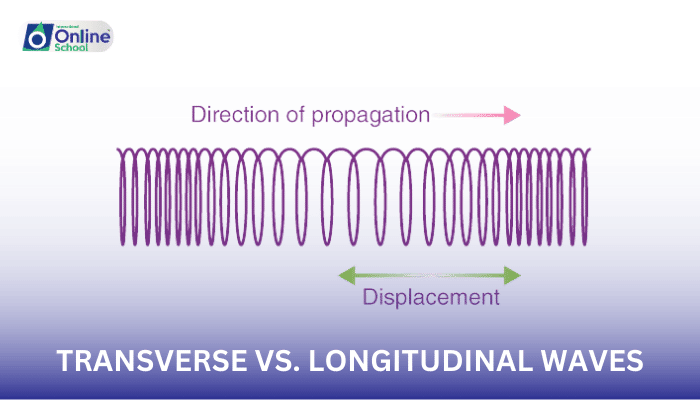
iv. Define longitudinal waves, understanding that the particles of the medium oscillate parallel to the direction of propagation.
v. Provide real-world examples of longitudinal waves, such as sound waves and vibrations in springs.
Introduction
As we observe the rhythmic motion of a rope held taut and shook or the mesmerizing dance of light rays illuminating a room, we witness two distinct forms of wave motion: transverse waves and longitudinal waves. This lesson delves into the captivating realm of waves, exploring their contrasting characteristics and their diverse manifestations in the physical world.
i. Transverse Waves: A Symphony of Perpendicular Oscillations
In transverse waves, the particles of the medium oscillate perpendicular to the direction of propagation. This oscillation creates a ripple effect that propagates through the medium, reminiscent of the motion of a rope held taut and shook or the gentle waves spreading across a pond.
Examples of Transverse Waves: A Tapestry of Vibrations
Transverse waves manifest in diverse phenomena:
Water Waves: The rhythmic ripples that spread across a pond or ocean surface represent transverse waves propagating through water.
Vibrations in Ropes: The up-and-down motion of a rope held taut and shook exemplifies transverse waves propagating through solid media.
Light Waves: The captivating dance of light rays illuminating our surroundings consists of transverse electromagnetic waves.
ii. Longitudinal Waves: A Symphony of Parallel Oscillations
In longitudinal waves, the particles of the medium oscillate parallel to the direction of propagation. This oscillation creates a series of compressions and rarefactions, regions where the particles are crowded together and spread apart, respectively.
Examples of Longitudinal Waves: A World of Vibrations
Longitudinal waves manifest in various phenomena:
Sound Waves: The vibrations generated by our voices or musical instruments create sound waves that travel through air, allowing us to hear and communicate.
Vibrations in Springs: The compression and expansion of a spring exemplify longitudinal waves propagating through solid media.
iii. A Tale of Contrasting Oscillations: Transverse vs. Longitudinal Waves
Transverse waves and longitudinal waves exhibit distinct characteristics:
- Direction of Oscillation: Transverse waves involve oscillations perpendicular to the direction of propagation, while longitudinal waves involve oscillations parallel to the direction of propagation.
- Examples: Transverse waves include water waves, vibrations in ropes, and light waves. Longitudinal waves include sound waves and vibrations in springs.
Transverse waves and longitudinal waves, with their contrasting characteristics, play crucial roles in our physical world. Transverse waves provide the mesmerizing dance of light and the gentle ripples on a pond, while longitudinal waves enable us to hear and communicate through the rhythmic vibrations of sound. As we continue to explore the realm of waves, we gain deeper insights into the fundamental workings of nature, from the intricate mechanisms of sound transmission to the captivating beauty of light and color.
